Showing posts with label Faith. Show all posts

Saturday, October 10, 2015

Faith & Form


This afternoon we enjoyed Community Day at Grace Farms in New Canaan, Connecticut. Grace Farms is an 80-acre former horse farm operated by the Grace Farms Foundation, which describes it as a place where people can "experience nature, encounter the arts, pursue justice, foster community, and explore faith." The event was one of several this weekend to mark the inauguration of a new facility.


The architecture of the new complex is quite stunning. Designed by the Pritzker Prize-winning Japanese architectural firm SANAA, the main building, known as The River, meanders down the hill in the form of a large, sinuous canopy that "pools" in several areas to enclose programmatic spaces: sanctuary, library, commons, pavilion, court. Its the kind of sinuous modernism I particularly enjoy. My wife described it as "opulent in its minimalism." I quite agree.


Several times during the day, I heard the new facility described as a "gift" to the greater community, and indeed programming for the newly-opened complex already includes use of the sanctuary as the new permanent home of Grace Community Church's Sunday worship services. I had read that the vision for Grace Farms was inspired by the Christian faith, and that it had the intent of house the Grace Community Church, but this last connection was what was curious to me.

I am a Christian and my faith is central to my life. I also value the arts. Since both of these are initiatives of Grace Farms, no problem, right?

In this particular place, though, I was finding it difficult to square faith and art (and more to the point, architecture) in my mind. I was struck by the cognitive dissonance going on in my head as we explored the grounds.


On the one hand, the building is pretty stunning as a work of architecture. Less a building than a pavilion, or even a folly, the architect in me loves the idea of this type of minimalist artistic locus, on the rolling hills, overlooking nature. It's a bit of a romantic notion, I'll admit.

But this is no run-of-the-mill work of architecture. It's a no holds barred, no expenses spared work. I mean, there's hardly a flat piece of glass in the whole place! It takes a lot of expertise and precision, and therefore money, to create something so effortless. Less may be more aesthetically, but it's often more work.


To put it plainly, then, given the extravagance of the building, I couldn't help myself thinking, couldn't the millions and millions of dollars I'm sure it cost be better used elsewhere supporting churches or other faith-based programs? Why spend so much on a facility?

If the complex had been built by a secular arts organization, no problem. But this? Cognitive dissonance.

Here's why I hated that thought in my head, though. Was I suddenly thinking that art and architecture were not a worthy Christian pursuit? The connection between faith and the arts have throughout history produced some amazing things: Cathedrals, Renaissance paintings, Handel's Messiah.


We meandered up the River and found ourselves in the Sanctuary at the top of the hill at the end of the afternoon just in time for a performance.

The first act was a teen pianist who played a Chopin Polonaise. But this wasn't any ordinary teen. The severely autistic teen was a participant in a program called Arts for Healing, where he flourished as a pianist. And that program--the one where this young man had discovered a true gift and a way to communicate and connect with the world when words failed--we were told was going to start being held in one of the brand new facilities at Grace Farms. Warming.

Then out walked the gospel choir. Their performance was amazing, and I found myself particularly enthralled by the woman signing in the choir. Yes, I did mean to say "signing," not "singing." As in, sign language. (As an aside, I've always loved signing choirs. My home church as a teen used to frequently have a signing choir visit, and I was always amazed.) Warming.

Then out came the modern dance troupe. Together with a vocal soloist and gospel choir backup, the dancers interpreted the story from Matthew 28 when Mary Magdalene came to Jesus' tomb only to find it empty and was told by an angel that he had risen from the dead.

That's it. Bingo.


During this performance it hit me. This is why this facility is here; this is what the Foundation is after. This is faith. This is art. In this place full of architects (who like me were probably more interested in the building than the Foundation and its goals) and curious community members the name of Jesus was used unabashedly. Art and faith. Faith and art.

When the choir started their last piece, the young autistic man who had played the piano stood up in his seat and started dancing, unashamed and with what I imagine to be "faith like a child." But he broke the ice. The audience stood, clapping along. It was pretty amazing.


I'm still not feeling entirely squared on this, but I suppose I'm less worried about how much the building cost at the moment. Instead, I hope and pray the facility will be used to provide the opportunities the Foundation seeks: for community engagement with the arts, bound by faith, among nature, seeking justice.


Saturday, September 6, 2014

Sermon Series Web Graphics

Last summer I had the awesome opportunity to design the website graphic for my church's sermon series in Book Two of the Psalms. Since then, I've had the pleasure of working with one of the pastors to create several additional sermon banners. The process has been fun and it has been a chance for me to expand my graphic design exposure.

Next week, we will begin a sermon series on the story of Joseph contained in Genesis chapters 37 through 50. The title of the series, God Meant it for Good: the Gospel According to Joseph, is based on a passage at the end of chapter 50 where Joseph reassures his brothers, who had previously sold him into slavery, that what they had meant for evil, God had meant for good. (Read the whole story starting in chapter 37.)

Now, when many people think of Joseph, they think of his famous coat of many colors. Though the coat is a relatively small detail near the beginning of Joseph's story, this was my first association as well, and I initially started thinking of using a colorful textile pattern as the backdrop for the graphic. However, I was unhappy with the uber-literal concept. We weren't, after all, staging a revival of Joseph and the Amazing Technicolor Dereamcoat! I began to wonder, what could I use that is colorful, textured, and layered, but isn't a literal piece of fabric?

After some web sleuthing, I settled upon the hand-marbled end papers often found in antique books, and I remembered that I had just the book: a mid-nineteen century edition of Alexander Pope's poetry with some awesome marbling. I photographed the end papers and, through the magic of Photoshop, transformed the warm palette of the original to a cool blue palette that worked with the blues of the church logo and website.


With the addition of simple text, including the series title and key verse, the result is a textured, colorful graphic that, I hope, offers open associations. Yes, it is colorful like Joseph's coat. But it is also textured, layered, and nuanced--much like the story of Joseph. It also brings to mind, perhaps, the old family Bible, passed down through generations. Or the textures of a middle-eastern desert. Or perhaps the subtle blue waves of the Nile River from Joseph's Egyptian exile.


Within the past year, I've also produced two additional website graphics.

Our previous Sunday morning sermon series, which began in fall 2013 and was completed over the course of a year, was entitled Looking to Jesus: A Series in the Book of Hebrews. The solution for that particular graphic was entirely typographical, with the series title and key verse floating over top of a background listing all of the names of Jesus used in Hebrews.


Lastly, the Sunday evening sermon series for fall 2013 was entitled The Real Jesus: A Series in the Gospel of Mark. For the website graphic, a simple silhouette of Jesus from one of the church's stained glass windows is cut out of a cool blue background gradient based on the colors of the church's trefoil logo.


Monday, June 3, 2013

Thirsting for God

My soul thirsts for God, for the living God. - Psalm 42:2 
Recently I was asked by one of the pastors of my church in New Haven, Trinity Baptist, to design the website graphic for the upcoming summer sermon series. The series, which begins next week, will focus on selections from Book Two of the Psalms (Psalms 42-72). The title of the series is Thirsting for God.

Almost immediately I began to picture the image of a cup--a chalice--representing our "Thirst" for God. I envisioned the icon of a cup nesting within itself and tessellating across the page, functioning as a wallpaper-like background for text which would provide details about the series.


I discussed the concept and sketch with my pastor. He pointed out that, alongside the thirsting metaphor in the Psalms, was the recurring theme of God's kingship. We discussed the idea that perhaps the cup could morph into a crown to represent God as King.

In the spirit of M.C. Escher, I had hoped to transition the individual cups into individual crowns. But try as I did, I could not come up with a crown tessellation which worked well as the end point for the cup-to-crown transition, much less figure out how one would become the other!

The beauty of the cup tessellation, I felt, was that it was a single form that nested perfectly within itself. I could nest a crown with an upside down crown. Or a crown with some other shapes to make up the difference. But this did not seem as elegant as nesting the cup with itself over and over again.

As my brain still spun, hoping to work out a solution, I further developed the details of the cup pattern in AutoCAD and Illustrator. Even though I knew that I would produce the final graphic in Illustrator and InDesign, I tend to work faster in AutoCAD for vector-based line work, so that is generally where I start for producing precise geometries before importing the line work into the Adobe products.


In the mean time, I dove into the Psalms with the hope of prompting some further inspiration. Though other royal symbols are mentioned--a scepter (45:6), a throne (45:6, 47:8, 55:19), a palace (45:8,15)--they are more obscure as symbols of kingship and would be more difficult to render in a simple iconic form than the more-recognizable crown--which, incidentally, is not mentioned in Psalms 42 through 72. Creating an icon for other, but more abstract, kingly attributes mentioned in the Psalms--majesty (45:4), righteousness (45:4,7, 48:10, 50:6, 51:14)--would have been an even more obscure and daunting task.

As I read through the Psalms, however, the cup metaphor continued to hold water--if you will pardon the pun. There are numerous references to thirsting, to water, to the sea, to cleansing.


As a deer pants for flowing streams,
so pants my soul for you, O God. - Psalm 42:1

Deep calls to deep at the roar of your waterfalls;
all your breakers and your waves have gone over me. - Psalm 42:7

My heart overflows with a pleasing theme. - Psalm 45:1

Grace is poured upon your lips. - Psalm 45:2

God is our refuge and strength,
a very present help in trouble.
Therefore we will not fear though the earth gives way,
though the mountains be moved into the hear of the sea,
though its waters roar and foam,
though the mountains tremble at its swelling. Selah.
There is a river whose streams make glad the city of God,
the holy habitation of the Most High. - Psalm 46:1-4

Wash me thoroughly from my iniquity
and cleans me from my sin! - Psalm 51:2

O God, you are my God; earnestly I seek you;
my soul thirsts for you;
my flesh faints for you,
as in a dry and weary land where there is no water. - Psalm 63:1

Save me, O God!
For the waters have come up to my neck.
I sink in deep mire,
where there is no foothold;
I have come into deep waters,
and the flood sweeps over me.
I am weary with my crying out;
my throat is parched.
My eyes grow dim
with waiting for my God. - Psalm 69:1-3

May he be like rain that falls on the mown grass,
like showers that water the earth! - Psalm 72:6


I went to bed with the Psalms and the cup tessellation swimming around in my head, and--I kid you not--the key to the solution to the cup/crown dilemma ultimately came to me while I was dreaming. I dreamed about the pattern transitioning across the page, with pieces of the tessellation dropping out to reveal a crown formed by turning several cups very subtly into the prongs of a crown.

As with most ideas that come in the middle of the night, there were some gaps, and the idea still took some development and editing beyond my subconscious designer. (The bright purple and green paintbrush strokes that overpowered the image, for instance, never saw the light of day.) The big break-through, however, was the idea of transitioning many cups into one crown. 


Also an overnight breakthrough was the realization that the pattern would drop away to reveal something else rather than be one consistent wallpaper across the page. The changing patterns of negative space worked to provide visual interest and slowly reveal the crown.

There are four colors used in the graphic. The three blues are from Trinity Baptist Church's logo (a riff on the traditional ecclesiastical trefoil pattern symbolizing the Trinity), and the gold is a Pantone mix I found online. Working in Illustrator, I tried a couple of patterns of blues and gold, and ultimately realized that a small white outline helped to define the cup by keeping the colors from running into each other.

Once I had the extents of the wallpaper pattern, which in the full graphic cuts off mid-cup in order to insinuate the pattern extending off the page, I started to drop away the cups to reveal negative space. To my mind, the major trick to patterns is finding some way to change them in a regular way that has enough variation to still be interesting. It is incredibly daunting to create something "random" that appears well-thought-out and visually pleasing. Defining "rules" for myself is always a good bet.


The page moves from lower left to upper right where density decreases and all that is left is the golden cups and the newly-revealed crown. The crown is set apart from the cups with a slightly larger white line than is typical, and the base of the crown provides space for the text description of the sermon series. For better or worse, there are seven prongs on the crown, seven being a significant Biblical number.


Typeface selection is always tricky and will invariably please some people while offending others. Working with a severely limited palette of decent options currently installed on my computer, I selected Trajan (1989, Carol Twombly) for the title and subtitle and Palatino Italic (1948, Hermann Zapf) for the Bible verse. Though Trajan has a reputation as an overused "movie font," its roots in the letterforms used on Roman inscriptions seemed appropriately authoritarian and royal. Palatino is a delicate font which I am usually drawn to because I love the upper case P in its Roman form. However, in Italic form it seemed to play particularly well with Trajan, which does not have lowercase letterforms (it uses small-caps instead).

Following some of the typographic conventions I learned last fall at a seminar with the University Printer of Yale University, I cleaned up the text. Some of the refinements include increased tracking for the small Italic text to aid in legibility and use of old-style numerals for the year and the Bible verse citation. The vector-based line work of the pattern was produced in Illustrator, which was then linked into InDesign for setting of the typography prior to exporting the final PDF and JPG files.

The finished graphic looks like this on the homepage. Clicking on the image takes one to the sermon list and sermon audio.


I really enjoyed this project and was honored to have been asked to work on it. Good graphic design can help draw people in to engage with deeper content, and I hope that this particular graphic serves that purpose.

However, I acknowledge that I submit this work to the public eye humbly and do not write this now as a "look at me, look at me" post. Rather, I mostly wanted to describe some of the thinking and work that went into the design process.

And it is a process. Design is at one time rewarding and frustrating; thinking and feeling; inspiration and execution. It is taking an idea far enough. It is not taking an idea too far. It is deciding when to quit because further work risks muddying the concept or the execution.

My hope is that the cup-to-crown imagery is subtle, that it may take some time to decipher, but that it is visually pleasing enough to look at long enough to think about some of this deeper symbology.

As I continue to reflect even now on the symbolism of the cup and crown in anticipation of the upcoming sermon series, I am reminded of Jesus' conversation with the Samaritan woman at the well from the Gospel of John. In the encounter, the woman has come to draw water from the well to quench a very real physical thirst. But Jesus--the King--turns that thirst into a metaphor for our spiritual thirst, as is so poetically described in the Psalms.
Everyone who drinks of this water will be thirsty again, but whoever drinks of the water that I will give him will never be thirsty again. The water that I will give him will become in him a spring of water welling up to eternal life. - John 4:13-14

Friday, March 18, 2011

Great & Unsearchable Things

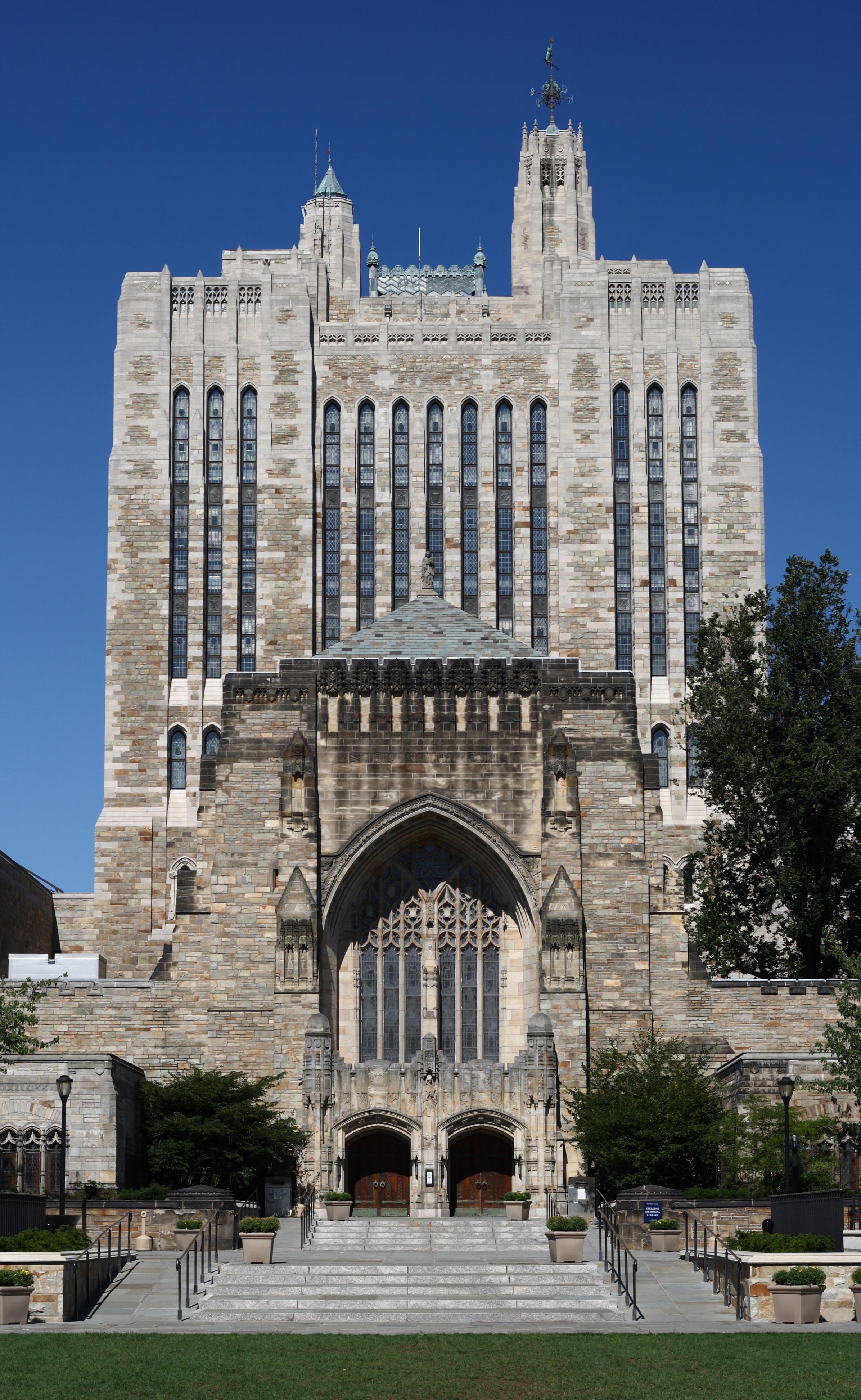
This afternoon, I was walking home from work when I overheard a group of three Yale undergraduates ruminating over the design of the Sterling Memorial Library.

"But is it a church that's supposed to be a library, or a library that's supposed to be a church," said one student to the others.

My walk followed them for about a block and I tried to listen in. By the way they were talking, I assumed they were not architecture students, so I was interested in what non-architects were saying about the neo-gothic edifice. I almost inserted myself in their conversation at one point, but was too timid to do so.

What was going through my mind was this . . .

If I had to pick from your two options, I would say the latter: it is a library that is supposed to be a church. That is to say, in a post-Christian society and secular university setting, it is a replacement for the church as a house of worship. As such, it is, in both style and veneration, a cathedral to knowledge--a secular humanist's temple to reason and knowledge. (Compare this also to Yale's mammoth neo-gothic Payne Whitney Gymnasium as a cathedral where the human body is worshiped.)

But, I wanted to add, as a Christian, I was reminded of a passage from the Bible:
Then Paul stood in the midst of the Areopagus and said, “Men of Athens, I perceive that in all things you are very religious; for as I was passing through and considering the objects of your worship, I even found an altar with this inscription:

TO THE UNKNOWN GOD.

Therefore, the One whom you worship without knowing, Him I proclaim to you: God, who made the world and everything in it, since He is Lord of heaven and earth, does not dwell in temples made with hands. Nor is He worshiped with men’s hands, as though He needed anything, since He gives to all life, breath, and all things. And He has made from one blood every nation of men to dwell on all the face of the earth, and has determined their preappointed times and the boundaries of their dwellings, so that they should seek the Lord, in the hope that they might grope for Him and find Him, though He is not far from each one of us; for in Him we live and move and have our being." (Acts 17:22-28, NKJV)
I imagine that the portal of the Sterling Memorial Library could have the same inscription Paul found in Athens, and that I could say the same thing to many students. Yale is, after all, an environment that breeds and encourages the religious pursuit of knowledge, reason, and objective reality. But "Do you not know? Have you not heard? The Lord is the everlasting God . . . his understanding no one can fathom." (Isaiah 40:28, NIV)

God, therefore, is the source of all knowledge, and he urges people to call on him for true understanding. "Call to me and I will answer you and tell you great and unsearchable things you do not know." (Jeremiah 33:3, NIV)

Book learning is just book learning, and Sterling would be an empty shell if it were not for God, "for the Lord gives wisdom; from his mouth come knowledge and understanding." (Proverbs 2:6, NIV)

Sunday, March 6, 2011

A Different Type of Mission

It has been a week since I left Peru, and I have been working on a letter to send to many of the people who have prayed for me or supported me financially on this journey. Below is a copy of that letter.


“Unless the LORD builds the house, the builders labor in vain.” (Psalm 127:1)

I returned last week from the mission trip to Peru with Engineering Ministries International (EMI) that I wrote to you about in January, and so I wanted to follow-up to thank you for your prayers of support for the mission and to tell you about my experience serving the Lord in South America.

Our EMI team consisted of eighteen members from the United States, Canada, and Costa Rica. All together, we were two EMI leaders and their spouses (plus one cutie-pie of a six-month-old), two architects, a master planner, two structural engineers, two civil engineers (plus one spouse), one electrical engineer, one surveyor, two EMI interns, and one drafter. Our team had been gathered by EMI’s Latin America office to work with a Seminary in Urubamba, Peru, on the master plan design of a new campus on land they own a few blocks from their current facility, the design of a dormitory for the new campus, and the design of a church on one corner of the property. My main task for the week was the architectural design of the dormitory.

Though I am confident that many on the team would vouch for the emotional and spiritual “high” that we all experienced working together for the Lord in Peru, I would go even further and say that the week for me was life-changing. So often I have thought of “missions” as standing on the corner with a Bible (and that’s a pretty scary thought for me even now!), but my recent trip to Peru opened my eyes to a different type of mission work. In our case, our team was supporting a Seminary ministry that seeks to equip Peruvian nationals and Quechua natives to be leaders in their local churches. During the week, our team delighted in the thought that, although we were not ourselves equipped or able to teach all of these people in the long-term, we were working together to design facilities that would serve the Seminary for years to come as they reached hundreds of students, and by extension, thousands of Peruvians with the power of the Gospel.

In one of our sporadic conversations while I was away, I was explaining some of these things to Kim, and she said to me, “Do you remember when I first said the word ‘missionary’ to you, and you looked at me like I was from outer space?” I said, “Yeah, but I didn’t know a missionary could be an architect!” But the truth is they can, and they are, working every day with organizations such as EMI. I think God showed me a lot during the week, one of the primary things being that I have something to offer in a mission setting such as this. During one of our team’s morning devotionals, we discussed the body of Christ as being like our own body, made up of diverse and separately-gifted members that must work together to accomplish anything. I may have been an eye during week, but I needed help from others to hear. But I was an eye for the week. And along with a team of ears, and hands, and feet, we worked together to serve the Lord. “Just as a body, though one, has many parts, but all its many parts from one body, so it is with Christ. . . . Now you are the body of Christ, and each one of you is part of it.” (1 Corinthians 12:12, 27)

Although before my trip, I had often felt that God had gifted me with both passion and skill in architectural design, I also often wondered how God desired me use these gifts. Amidst a hectic week where there was the same amount, if not more, work than in my professional life, I found a peace and renewed passion in my love for architecture by serving the Lord.

Some might say that I went to Peru to do something “good” for others, or to “help” someone else. But as is often the case when we are in a position to be a blessing to others, we are in turn blessed even more in return. I was amazed and encouraged, therefore, at the spirit of service-in-love that was demonstrated to us by our hosts at the Seminary in Urubamba. Just when we might have been tempted into feeling good about ourselves in what we were doing, we were humbled by others seeking to serve us with selfless hearts.

Although each member of the team has now returned home from Peru, there is still much work to be done. Over the next few months, we will be working together and coordinating in the midst of our day-to-day professional lives to complete the master plan document and the construction documents for the dorm which are the deliverables offered in this case by EMI to the Seminary. I would appreciate your continued prayer support for my work moving forward, the work of the other volunteers, and especially the work that the Seminario Evangélico Bautista Independiente del Cusco (SEBIC) is doing in the lives of Peruvians in the region of Cuzco.

If you would like to read more stories or see more photos from the trip, visit my blog “Through the Oculus” at throughtheoculus.blogspot.com. To find out more about EMI, visit their website at emiworld.org. If you are specifically interested in learning about EMI’s work in Latin America, their website is emiamericalatina.org.

Yours in Christ,

Saturday, February 26, 2011

Once-in-a-Lifetime Twice

Our EMI team arrived to Machu Picchu Saturday morning after an early pickup from the seminary where we were staying and a two hour train ride through the Sacred Valley of the Incas from Ollantaytambo to Aguas Calientes. There was a light drizzle as we entered the park, and a white mist shrouded the tops of the mountains all around us. As we followed the pathway around the edge of the mountain and into the ancient city, the rain passed, and the clouds started to move away as the ruins of the last great city of the Incas was revealed to us.

When I saw this same sight for the first time a number of years ago—the morning mist lifting from Machu Picchu—I never thought I have any reasonable chance of seeing it again. In 2005, Kim and I visited Machu Picchu together when we went to Peru on vacation (it was the farthest south we could get on the Delta SkyMiles I had accrued flying back and forth from Atlanta to Pennsylvania when I was an undergrad at Georgia Tech!). Back then, I could not have expected that I would ever return. It is, after all, a once-in-a-lifetime experience.

I feel extremely blessed to have that once-in-a-lifetime experience twice in my life. And let me tell you that the majestic site, sitting impossibly on the top of a mountain, surrounded by towering green peaks and tropical vegetation, was just as awe-inspiring the second time as the first. It is truly one of the most amazing places I have ever been, both for the stunning natural beautiful of the location and for the absolute precision of the ancient stone architecture.

Although photos can never do a site like Machu Picchu trues justice, here are some images from our trip.

The whole team standing on the overlook to Machu Picchu. This is the postcard view of the city, with the peak of Wayna Picchu behind.

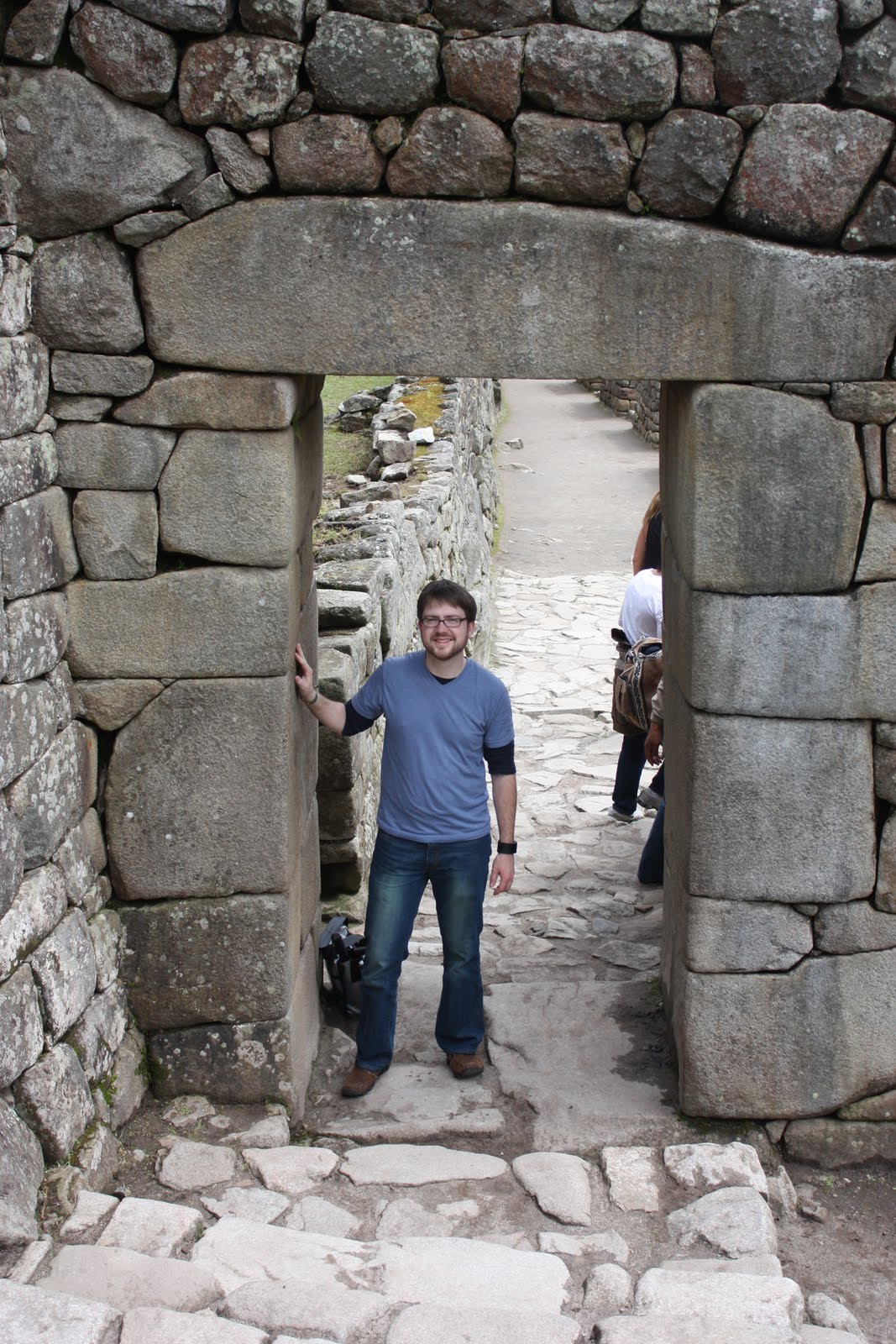
Me at the main gate to the city.

Ten of us in the group decided to climb to the peak of Wayna Picchu, a trek that Kim and I made in 2005 when we went. The trail is trecherous, dangerous, not for the faint of heart, and not at all designed for easy accessibility. But the view was worth it! Here we are sweaty, tired, and aching, with the city of Machu Picchu appearing as a clearing in the distance. The whole round-trip took us about two-and-a-half hours.

What goes up must come down! Going up is tiring, but going down really hurts the legs! At times, the steps are so shallow you have to crawl on your backside, or turn around and climb facing the steps like a ladder. Yes, these are my feet; no there are no railings; yes, if you miss the bottom step you would plummet thousands of feet to your death.

The ancient city of Machu Picchu is characterized by stone buildings with steep roofs and small windows situated impossibly on terraces which cascade down the side of a mountain.

Machu Picchu has a pretty sophisticated system of aqueducts. Seeing the playful waterfalls, tunnels, and watercourses carved out of the stone, I couldn't help but think that the Inca were not just concerned with function, but also with beautiful design. Some of the lyrical shapes they used throughout the site appear to be designed and crafted for the sake of beauty, not just function.

Some of the rocks on site appear to mimic the form of the mountains beyond.

A beautiful example of an Inca doorway, with sloped sides for seismic stability. Archeologists surmise that the handle-looking stones to each side of the door and the donut-like stone above used to lock a door in this opening.

Inca stonework and stone carving is amazing. One of the other EMI team members saw this and said, "it looks like they just poured the stone in." Truly, the stonework at Machu Picchu (and other Inca ruins in Peru) is so precise you would be hard-pressed to fit a knife edge into most of the joints.

A view of some of the stone terracing that is prevalent at Machu Picchu.

Both times that I visited Machu Picchu I was struck by the unity of the forms of the architecture with the forms of the landscape. Just look at the shape of the building gables superimposed over the mountain in the distance!

Friday, February 25, 2011

The End of the Rainbow

Visiting Peru during rainy season is sort of like playing roulette with the weather. Though we have had some sunny patches this week, most of our time here in Urubamba has been characterized by drippy rain followed by clouds followed by heavier rain.

Then repeat as necessary.

Today, however, was glorious for most of the day: white fluffy clouds, clear blue skies, lush green vegetation on the mountains, sunlight to warm our rain-cooled bones. It was even clear enough to see a hind of the glacier that sits just up the valley from Urubamba!

What torture to sit inside working away on our designs as we prepared for our 4:00 meeting with our clients! How discouraging to be inside on a day such as this!

But God is faithful in reminding us of his sovereignty just when we need it the most. Just before our meeting began, while people were running around frantic getting the room set up and making last minute changes in AutoCAD, I heard one of our team members shout, “James, get your camera and come look at this!” Not knowing what to expect, I stopped what I was doing, grabbed my camera and exited our work room to behold one of the most vibrant rainbows I have ever seen in my life. There it was, hanging from the sky in the east, just over our project site, illuminating the city of Urubamba and making the far mountains appear purple and shimmery.

Calm. Awe. God’s promise.

This week has been life-changing. Amidst a hectic week where there was the same amount, if not more, work than in my professional life (staying up past midnight 3 days in a row is not my normal M.O.), I found a peace and renewed passion in my love for architecture. Some might say that I came on this mission to do something “good” for others, or to “help” someone else. But so often when we are in a position to be a blessing to others, we are in turn blessed even more in return. For example, I have been amazed at the spirit of service-in-love that has been demonstrated to us by our hosts here at the seminary in Urubamba. Just when we want to feel good about ourselves in the “good” we ourselves are doing, we are humbled by others seeking to serve us with selfless hearts. And I have been humbled by the testimonies of the other members of this team—all of us have grown closer than anyone deserves to grow in only 6 days. I will certainly miss working with all of them when I return to the “real world.”

In one of our sporadic chat correspondence this week, Kim said to me, “Do you remember when I first said the word ‘missionary’ to you, and you looked at me like I was from outer space?” I said, “Yeah, but I didn’t know a missionary could be an architect!” But the truth is they can, and they are—every day. I think God has shown me a lot this week, one of the primary things being, that I have something to offer in a mission setting such as this. The other day during our devotional time, we discussed the body of Christ as being like our own body, made up of diverse and separately-gifted members that must work together to accomplish anything. I may have been an eye this week, but I needed help to hear. But I could be an eye, on a team of ears, and hands, and feet.

I wanted so much to write Thursday night, but it was the latest night yet, and I was exhausted. It is late again tonight, but for good reason. Our presentation was almost 3.5 hours long, but it went really, really well. There is still much work to do to develop and finalize our designs for the seminary campus and church over the next few months, but I believe we accomplished our goal this week. We got to know the ministry we are serving, and they got to know us. I left the meeting feeling confident that the particular design I proposed this week for their new seminary dorm would serve the ministry for many years to come. Tired but happy, we left campus to have a team dinner out in town.

Tomorrow morning (actually, only like 4 hours from the time I’m writing this), we’re on a bus and train to Machu Picchu. I never thought when I visited Machu Picchu a number of years ago I would ever be back, but here I am. I’m really looking forward to it—it should be an awesome end to our week here in Peru.

Since I didn’t write Thursday, I have a bit of catching up to do. Here are some photos from the past two days.

Thursday morning, I lead worship time with Josh, one of the EMI leaders. This was after fixing the piano's sustain pedal with a broomstick, 4 nails, and a candle the day before.

Looking over the roofs of the current seminary and the town of Urubamba. To the north in the valley is a glacier. Although it's hard to distinguish where white cloud ends and ice starts, if you look closely, you can see the heart shaped area of mountain where a chunk of glacier fell off causing flooding a few years ago.

Our attentive clients, in front in the chairs. Our exhausted EMI team, on the benches in the back.

Finally, I thought perhaps it would be nice to post a bit of what I had been working on this week. I was predominantly responsible for the architectural design of the first dormitory to be built on the seminary's new site, just a few blocks east of their current facility. The dorm has rooms for 60 students, a laundry room, lounge, and staff apartment (like a dorm-parent) arranged in an L-shape around a landscaped courtyard. The predominant materials are rough textured stucco on the lower floor, smooth white stucco on the upper, with wood door and window frames. In order to fulfill the town's requirement that new structures on the seminary site have the traditional "teja" tile roof (or similar), and in order not to break the seminary's budget, the roof will be simulation clay tile.

Plan of the first floor. Dorm rooms will hold up to 6 people each. Each student was required to have a bed, a desk, and a dresser. In order to save space and make a smaller building on an already constrained site, we proposed the idea of lofted beds with desks and storage below. We showed them a couple of ideas, and they will be having their woodworker and students build the bunks for the dorm. The short leg of the L is a one-story building housing laundry, lounge, and staff apartment.

The south (top) and north (bottom) elevations of the dormitory building. Clerestory windows on the south elevation (away from the sun in this hemisphere) will help provide even daylighting on the upper level of rooms. In a country that very seldom uses heating or cooling, jalousie windows above a fixed window and a jalousie transom above the door provide cross-ventilation and fresh air.

West elevation of the dorm complex (top), with staff apartment to the left and bougainvillea climbing on the west wall of the dormitory. Section through the staff apartment (bottom left) and through the dormitory (bottom right), with the west elevation of the staff apartment in the distance.

Wednesday, February 23, 2011

Today I...

...went to the market.

...ate cuy (guinea pig), a Peruvian delicacy.

...fixed the sustain pedal on the seminary's grand piano with a broomstick, 4 nails, and a candle.

...played party games with the natives.

...had a cross-cultural Portuguese-Spanish conversation with a Peruvian.


Don't worry, I also did some work!


Tuesday, February 22, 2011

Inspiration

Last night after reading and preparing for this morning's devotion, I couldn't quite sleep. I flipped on the light and started sketching and fleshing out some ideas that had been rolling around in my head after it became evident yesterday afternoon that my initial idea for the dorms would be impossible given certain restrictions of the site. After a few minutes of drawing, at peace with my progress, I put down my pen, flipped off the light, and fell asleep to the sound of rain on the metal roof.

Today was perhaps the busiest day so far. After breakfast, devotions, and our morning team meeting, I went straight to work drafting and developing the sketches for the dorms. As the rain cleared up mid-morning, the other architects and I decided to take a more extensive walk through town to take stock of the architecture, take photos of details, and research materials and methods of construction. We arrived back for lunch as the rain started up again.

After lunch, I glued myself to my laptop and worked diligently to flesh out the basics of the building in a way the client could understand. On an intense mission such as this, we have scheduled client meetings every afternoon, and so progress must be made or else decisions are delayed, and completing the schematic design in time would be impossible. My first meeting with our client to discuss the specifics of the dorm design went well (previous meetings were mostly about programming--what goes into the dorms--not what they look like). At this point, I just continue moving the design forward as quickly as possible and detail as much as possible before the end of Friday. I'm not ready to share quite yet, but maybe by the end of the week, I'll post some images of the dorm design.

In other news, today was Glyn's birthday! Glyn is one of the structural engineers on the team--he and I are working together on the dormitory.

Here's an action shot of him blowing out his candles. In some sort of South American/Peruvian/Spanish tradition, everyone claps and counts, and the person having the birthday is supposed to blow out the candles when you get to their age. To protect the particular parties involved here, I won't tell what number we counted to!

And here are a few other photos from the day's activities.

This is a shot of our typical morning team meeting. Each team member describes what they accomplished the previous day, what the hope to accomplish during the day, and what materials and information they need from the other team members.

We walked past a market where we saw these cool flower pots made of old tires.

Ah, the mighty coca leaf. Good for tea, chew, and...um...cocaine.

And here are two more photos to close out the day which I hope speak for themselves.