Tuesday, April 12, 2011

The Mind, Once Expanded

(Above - The Haven String Quartet of Music Haven)

Music has been an important part of my life, even classical music, from a young age. I can remember special times with my Dad, laying on the living room floor on our backs next to each other, eyes closed, listening to music on the record player. As we would listen to each piece, he would ask me what I was seeing, feeling. A few of my favorite pieces from those memories were Aaron Copland's Rodeo, where we would take turns describing the sites and sounds of a rodeo (including a lazy, stubborn donkey in one movement!), and Johann Strauss' Blue Danube during which we would visualize the path of the famous river from source to sea.

Some of the pieces I listened to with my Dad, like Copland's, have grown to be like old friends, the comfort music I listen to when I want something familiar and safe. But I like new friends too, and I try to occasionally expand my listening repertoire with new pieces or composers. Like Copland's Symphony No. 3, for example. Though a relatively new addition to my listening repertoire, it has become one of very favorite symphonic pieces. Or work by Cuban-born Julian Orbon, a Copland disciple. His Concerto Grosso has hints of Copland's influence all over the orchestration.

Every now and then, however, a piece comes along out of the blue that totally rocks my world, upends my preconceptions, and speaks straight to my soul. This happened most recently at a recent performance of Kevin Volans' String Quartet No. 1 (White Man Sleeps) by the Haven String Quartet.

Volans, a South African-born composer, was previously unfamiliar to me until I was floored by the quartet's performance of White Man Sleeps. I had, after all, gone to the concert for the Beethoven, and after they played Beethoven first, I seriously though to myself, "I don't know how they're going to top that with a composer I've never heard of."

But top it they did! After a brief introduction to the piece by the violist, the quartet jumped straight into the aural fantasy that is White Man Sleeps. Hearing the piece for the first time live was an incredible experience, and it kept me enraptured for about a half an hour through all five movements. I felt like Lewis and Clark seeing the Pacific for the first time, "O! The Joy!"

Volans, a white man, was born and came of age in apartheid South Africa. He was educated in both South Africa and Europe and has lived most of his life outside of Africa. Inspired by field research and recordings of his native South Africa in the early 1980s, White Man Sleeps takes cues from traditional folk songs and instruments. Though Volans' piece breaks so many of the expectations of more traditional classical music and at times even challenges preconceptions of what musical beauty should sound like, the sounds, rhythms, and playing techniques seem to evoke the feeling of Africa to their very core.

In a statement about the piece, which was written in the early 1980s, the last full decade of South African apartheid, Volans says, "I wrote White Man Sleeps [as] the third in a series of pieces in which I hoped, perhaps somewhat naively, to reconcile African and European aesthetics. I wanted to reflect in the music an image of a multicultural society - one in which the traditions of different cultures are represented, honoured and, above all, shared - no more 'separate development'!" In the same theme, Volans said, "Like many white South Africans of my generation I was brought up to think I was European. I went to live in Europe and found this was not true. I returned to Africa and was disappointed to find I could not really regard myself as African."

As I have been reflecting on the piece (and listening religiously to a recording of it I bought on iTunes), I keep wondering why I have been so taken by the piece. It is an odd piece of music using conventional standards, so I must admit my ears were prepared by a few years of listening to even more peculiar 20th century classical pieces by such composers as John Adams, whose Hallelujah Junction for Two Pianos has so many odd an dissonant cords it sounds at times like a cacophony of broken carnival games, and Steven Reich, whose concept of phase music floored me when I learned about it for he first time and which still never ceases to excite me musically, intellectually, and scientifically. Part of my interest, then, is in White Man Sleeps' unique and innovative sound and feeling within the tradition of other 20th century classical pieces.

Part of it, though, is that it is by a South African and inspired by Africa. My parents lived in South Africa for a few years in the mid-2000s and I had the privilege of visiting twice. If you know me, you know I have a strong passion for Latin America, but upon returning from Africa, I told someone, "if I didn't already have such a deep love for Latin America, I think Africa would certainly be a place that would capture my heart." Africa can get under your skin and into your blood in a short amount of time. I wonder if that is what Volans experienced when he returned to his native land and was inspired to write this piece?

Knowing of Volans' explicit intent that the piece evoke the rhythms and sounds of Africa, I can, as if laying on the floor with my eyes closed, visualize while listening to the piece some of the things I saw first-hand in my visits--the long drive across the Karoo, the women carrying impossible bundles on their heads, the roadside craft stands, the tin shacks, the colors of traditional dress, the incredible landscape, the haunting sound of the dove calling "I love South Africa"--as well as many of the things one can only dream about or see on documentaries--the ceremonial dances of native tribes, the deep darkness of the dark continent, the power of tribal tradition, the legacy of apartheid and post-colonialism...

It has been said that talking about music is like dancing about architecture. But here I am writing about music on a blog about architecture! Part of the reason I decided to write about the piece is because I cannot stop talking about it, or listening to it, or thinking about it, and I hoped this outlet might let me express some of these pent-up feelings. I mostly want to relate the very visceral reaction I had to the piece within the context of my own art and composition--that of architectural design. I was thinking that I hope someone some day might experience the same sense of wonder at a work of my design as I experienced upon hearing this piece for the first time. But I know this is a nearly impossible task. The only building that I have seen in person that was able to evoke a similar reaction was the Pantheon, and those types of buildings come around only once every few millennia.

I have found some videos of the piece being performed by another quartet on YouTube. Though I hope you enjoy them, I am not able to vouch for the quality of the recording as I have not listened to them all the way through. Hopefully, though, they begin to whet your own appetite to find a better recording of the piece (there is at least one on iTunes) and experience its magic for yourself.

The first movement starts in immediately at a frenetic pace of complex rhythms. Do not let the quiet portion in the middle of the movement fool you into losing your focus. It is simply the eye of the storm before the frenzied finish!

Though picking a favorite movement of this piece would almost be like trying to pick a favorite child, I must say I cannot seem to get enough of this the second movement. As with the first movement, the tempo is fast from the beginning with slower sections used as a foil for the quicker parts. The beautifully melodic underlying theme is introduced immediately and it is woven through the entire piece over and over in different ways. Part way through the piece, the sawing rhythm intensifies suddenly as the violin takes on the theme before reintroducing it to the ensemble in a new way--the artists turn their bows over and hit the strings with the stick! Volans does not cease to surprise in this movement: the ending is like something you get from fast-forwarding a recording! This is a driving piece to me and reminds me of the vast scenery of the desert in a drive we did across the country.

The third movement begins entirely picked on the cello in a feat of what appears to be pretty advanced technique. The use of the cello in this manner gives the feel of traditional African instruments which may be hit or plucked instead of bowed. The other instruments come in part way through the piece and repeat their bird-like call through the end. This movement reminds me of the sad call of the dove that woke me each morning at my parents' house, "I love South Africa...I love South Africa...I love South Africa..."

The fourth movement starts quietly with a series of moving chords and parallel lyrical lines. A little less than half way through the piece, a small silence introduces a haunting lullaby like melody played on the viola to pizzicato accompaniment. The melancholic sadness of the piece fill my heart with sorrow for the painful history of the African continent--but its beauty reminds me of a lullaby a mother would sing as she hopes for better future for her child.

The best way to describe the fifth movement is "swarm." It reminds me of the frenzy of something you might see in a documentary on tribal coming of age customs. The muted sounds of the instruments move the piece from start to finish without ceasing, culminating in a satisfyingly unsatisfying ending that leaves the heart empty enough to want to listen again.

As I reflect on the few pieces of music over my lifetime that have done that thing where they simply make my jaw drop in awe, I am reminded of a quote by Oliver Wendell Holmes: "The mind, once expanded to the dimensions of larger ideas, never returns to its original size." Though I know I will get over my constant listening frenzy and White Man Sleeps will probably become one of the old friends I turn to from time to time for comfort, I feel fortunate to know that my world is just a little bit bigger than it was before I heard this piece.

Update

The Haven String Quartet performed this piece again today at the Yale Art Gallery (excepting movement 4). As with before, it was a special treat to experience this piece live.

Although the small introduction at the concert the other day was helpful, today's more in-depth discussion of the piece really added depth to my understanding of it, and to my appreciation for it. We heard recordings of some of the songs, instruments (one of which I can't remember the name of but looks an awful lot like the Brazilian berimbau with which I am familiar with from capoeira), and rhythms that had inspired Volans to write White Man Sleeps.

I really appreciated the gallery curator and the quartet walking us through some of the movements ahead of time, for instance highlighting the groups of 24 notes played 5 times through over and over again but at different tempos and different combinations of instrumentation. Also, on the theme of African music, it was noted that the musicians in African groups work together more than in the tradition of Western music. Whereas in Western music, we often venerate the man (the virtuoso) who can perform the work of 10 men, in African music, the group of 10 men work together to produce the whole. This can definitely be heard in the way Volans layers the parts of the piece and passes the lyrical melodies between the instruments.

I can't wait to listen for all this again the next time I listen to the piece...which will probably be in about 5 minutes when I finish my lunch, put on my headphones, and get back to work!

Friday, March 18, 2011

Great & Unsearchable Things

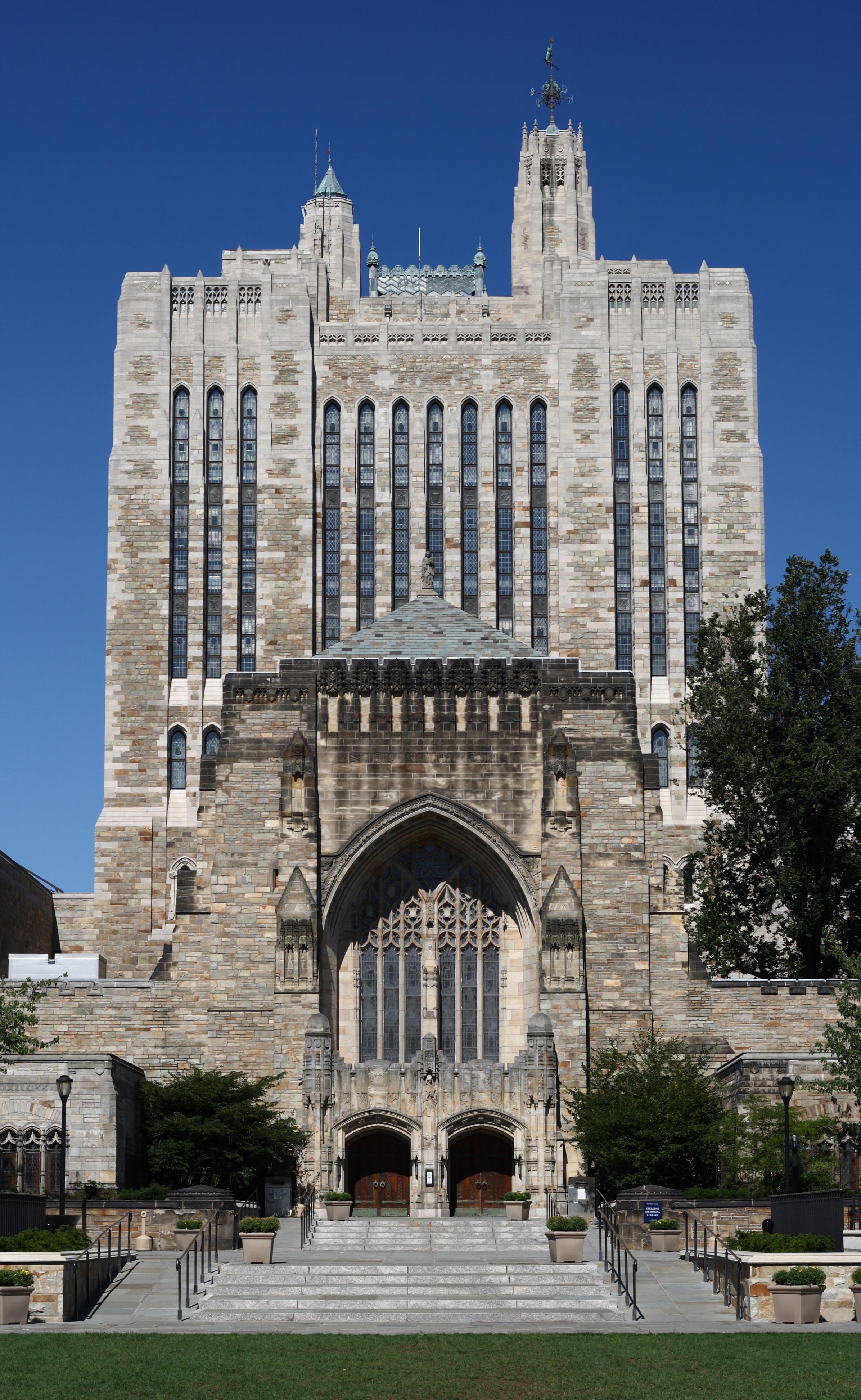
This afternoon, I was walking home from work when I overheard a group of three Yale undergraduates ruminating over the design of the Sterling Memorial Library.

"But is it a church that's supposed to be a library, or a library that's supposed to be a church," said one student to the others.

My walk followed them for about a block and I tried to listen in. By the way they were talking, I assumed they were not architecture students, so I was interested in what non-architects were saying about the neo-gothic edifice. I almost inserted myself in their conversation at one point, but was too timid to do so.

What was going through my mind was this . . .

If I had to pick from your two options, I would say the latter: it is a library that is supposed to be a church. That is to say, in a post-Christian society and secular university setting, it is a replacement for the church as a house of worship. As such, it is, in both style and veneration, a cathedral to knowledge--a secular humanist's temple to reason and knowledge. (Compare this also to Yale's mammoth neo-gothic Payne Whitney Gymnasium as a cathedral where the human body is worshiped.)

But, I wanted to add, as a Christian, I was reminded of a passage from the Bible:
Then Paul stood in the midst of the Areopagus and said, “Men of Athens, I perceive that in all things you are very religious; for as I was passing through and considering the objects of your worship, I even found an altar with this inscription:

TO THE UNKNOWN GOD.

Therefore, the One whom you worship without knowing, Him I proclaim to you: God, who made the world and everything in it, since He is Lord of heaven and earth, does not dwell in temples made with hands. Nor is He worshiped with men’s hands, as though He needed anything, since He gives to all life, breath, and all things. And He has made from one blood every nation of men to dwell on all the face of the earth, and has determined their preappointed times and the boundaries of their dwellings, so that they should seek the Lord, in the hope that they might grope for Him and find Him, though He is not far from each one of us; for in Him we live and move and have our being." (Acts 17:22-28, NKJV)
I imagine that the portal of the Sterling Memorial Library could have the same inscription Paul found in Athens, and that I could say the same thing to many students. Yale is, after all, an environment that breeds and encourages the religious pursuit of knowledge, reason, and objective reality. But "Do you not know? Have you not heard? The Lord is the everlasting God . . . his understanding no one can fathom." (Isaiah 40:28, NIV)

God, therefore, is the source of all knowledge, and he urges people to call on him for true understanding. "Call to me and I will answer you and tell you great and unsearchable things you do not know." (Jeremiah 33:3, NIV)

Book learning is just book learning, and Sterling would be an empty shell if it were not for God, "for the Lord gives wisdom; from his mouth come knowledge and understanding." (Proverbs 2:6, NIV)

Sunday, March 6, 2011

A Different Type of Mission

It has been a week since I left Peru, and I have been working on a letter to send to many of the people who have prayed for me or supported me financially on this journey. Below is a copy of that letter.


“Unless the LORD builds the house, the builders labor in vain.” (Psalm 127:1)

I returned last week from the mission trip to Peru with Engineering Ministries International (EMI) that I wrote to you about in January, and so I wanted to follow-up to thank you for your prayers of support for the mission and to tell you about my experience serving the Lord in South America.

Our EMI team consisted of eighteen members from the United States, Canada, and Costa Rica. All together, we were two EMI leaders and their spouses (plus one cutie-pie of a six-month-old), two architects, a master planner, two structural engineers, two civil engineers (plus one spouse), one electrical engineer, one surveyor, two EMI interns, and one drafter. Our team had been gathered by EMI’s Latin America office to work with a Seminary in Urubamba, Peru, on the master plan design of a new campus on land they own a few blocks from their current facility, the design of a dormitory for the new campus, and the design of a church on one corner of the property. My main task for the week was the architectural design of the dormitory.

Though I am confident that many on the team would vouch for the emotional and spiritual “high” that we all experienced working together for the Lord in Peru, I would go even further and say that the week for me was life-changing. So often I have thought of “missions” as standing on the corner with a Bible (and that’s a pretty scary thought for me even now!), but my recent trip to Peru opened my eyes to a different type of mission work. In our case, our team was supporting a Seminary ministry that seeks to equip Peruvian nationals and Quechua natives to be leaders in their local churches. During the week, our team delighted in the thought that, although we were not ourselves equipped or able to teach all of these people in the long-term, we were working together to design facilities that would serve the Seminary for years to come as they reached hundreds of students, and by extension, thousands of Peruvians with the power of the Gospel.

In one of our sporadic conversations while I was away, I was explaining some of these things to Kim, and she said to me, “Do you remember when I first said the word ‘missionary’ to you, and you looked at me like I was from outer space?” I said, “Yeah, but I didn’t know a missionary could be an architect!” But the truth is they can, and they are, working every day with organizations such as EMI. I think God showed me a lot during the week, one of the primary things being that I have something to offer in a mission setting such as this. During one of our team’s morning devotionals, we discussed the body of Christ as being like our own body, made up of diverse and separately-gifted members that must work together to accomplish anything. I may have been an eye during week, but I needed help from others to hear. But I was an eye for the week. And along with a team of ears, and hands, and feet, we worked together to serve the Lord. “Just as a body, though one, has many parts, but all its many parts from one body, so it is with Christ. . . . Now you are the body of Christ, and each one of you is part of it.” (1 Corinthians 12:12, 27)

Although before my trip, I had often felt that God had gifted me with both passion and skill in architectural design, I also often wondered how God desired me use these gifts. Amidst a hectic week where there was the same amount, if not more, work than in my professional life, I found a peace and renewed passion in my love for architecture by serving the Lord.

Some might say that I went to Peru to do something “good” for others, or to “help” someone else. But as is often the case when we are in a position to be a blessing to others, we are in turn blessed even more in return. I was amazed and encouraged, therefore, at the spirit of service-in-love that was demonstrated to us by our hosts at the Seminary in Urubamba. Just when we might have been tempted into feeling good about ourselves in what we were doing, we were humbled by others seeking to serve us with selfless hearts.

Although each member of the team has now returned home from Peru, there is still much work to be done. Over the next few months, we will be working together and coordinating in the midst of our day-to-day professional lives to complete the master plan document and the construction documents for the dorm which are the deliverables offered in this case by EMI to the Seminary. I would appreciate your continued prayer support for my work moving forward, the work of the other volunteers, and especially the work that the Seminario Evangélico Bautista Independiente del Cusco (SEBIC) is doing in the lives of Peruvians in the region of Cuzco.

If you would like to read more stories or see more photos from the trip, visit my blog “Through the Oculus” at throughtheoculus.blogspot.com. To find out more about EMI, visit their website at emiworld.org. If you are specifically interested in learning about EMI’s work in Latin America, their website is emiamericalatina.org.

Yours in Christ,

Saturday, February 26, 2011

Once-in-a-Lifetime Twice

Our EMI team arrived to Machu Picchu Saturday morning after an early pickup from the seminary where we were staying and a two hour train ride through the Sacred Valley of the Incas from Ollantaytambo to Aguas Calientes. There was a light drizzle as we entered the park, and a white mist shrouded the tops of the mountains all around us. As we followed the pathway around the edge of the mountain and into the ancient city, the rain passed, and the clouds started to move away as the ruins of the last great city of the Incas was revealed to us.

When I saw this same sight for the first time a number of years ago—the morning mist lifting from Machu Picchu—I never thought I have any reasonable chance of seeing it again. In 2005, Kim and I visited Machu Picchu together when we went to Peru on vacation (it was the farthest south we could get on the Delta SkyMiles I had accrued flying back and forth from Atlanta to Pennsylvania when I was an undergrad at Georgia Tech!). Back then, I could not have expected that I would ever return. It is, after all, a once-in-a-lifetime experience.

I feel extremely blessed to have that once-in-a-lifetime experience twice in my life. And let me tell you that the majestic site, sitting impossibly on the top of a mountain, surrounded by towering green peaks and tropical vegetation, was just as awe-inspiring the second time as the first. It is truly one of the most amazing places I have ever been, both for the stunning natural beautiful of the location and for the absolute precision of the ancient stone architecture.

Although photos can never do a site like Machu Picchu trues justice, here are some images from our trip.

The whole team standing on the overlook to Machu Picchu. This is the postcard view of the city, with the peak of Wayna Picchu behind.

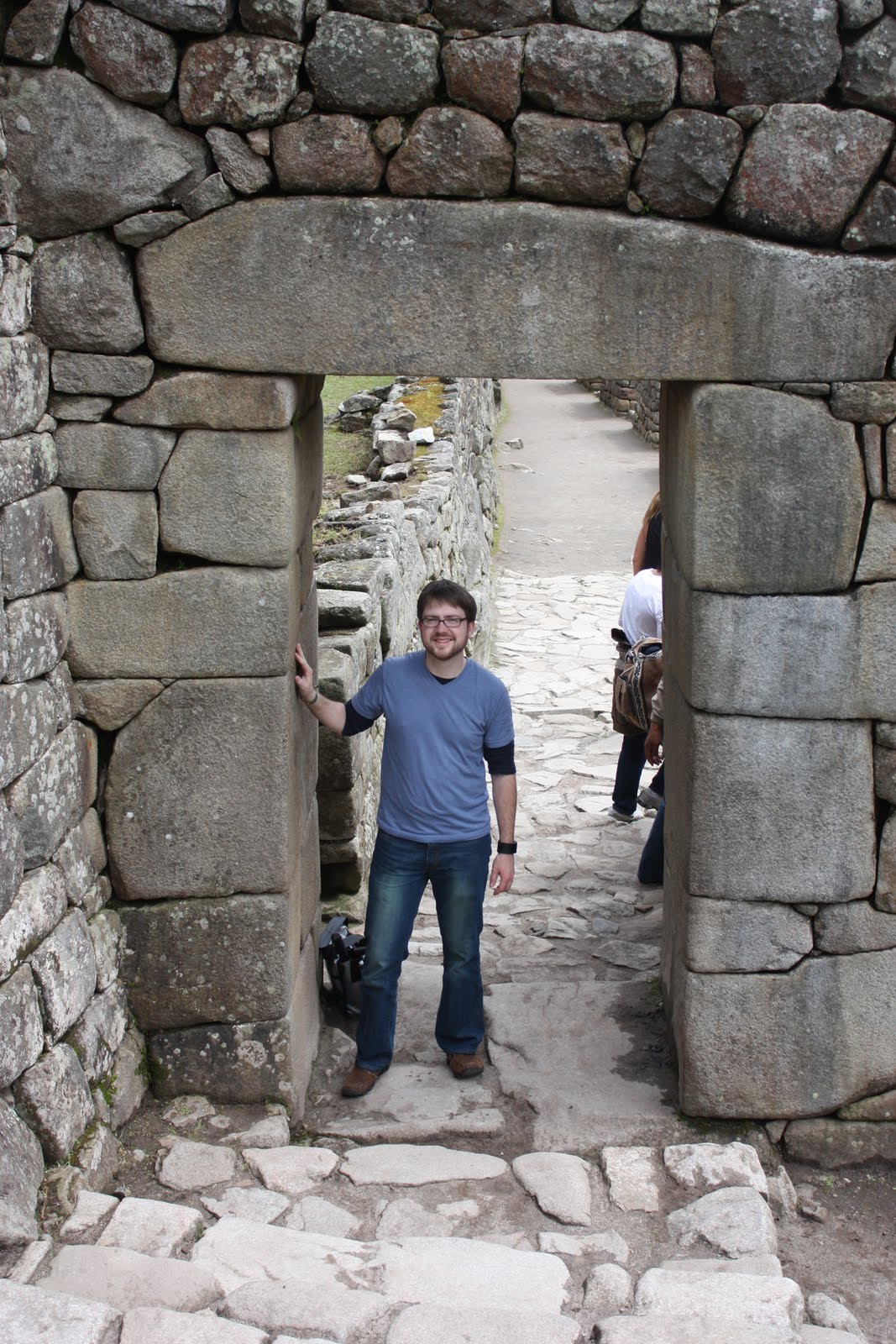
Me at the main gate to the city.

Ten of us in the group decided to climb to the peak of Wayna Picchu, a trek that Kim and I made in 2005 when we went. The trail is trecherous, dangerous, not for the faint of heart, and not at all designed for easy accessibility. But the view was worth it! Here we are sweaty, tired, and aching, with the city of Machu Picchu appearing as a clearing in the distance. The whole round-trip took us about two-and-a-half hours.

What goes up must come down! Going up is tiring, but going down really hurts the legs! At times, the steps are so shallow you have to crawl on your backside, or turn around and climb facing the steps like a ladder. Yes, these are my feet; no there are no railings; yes, if you miss the bottom step you would plummet thousands of feet to your death.

The ancient city of Machu Picchu is characterized by stone buildings with steep roofs and small windows situated impossibly on terraces which cascade down the side of a mountain.

Machu Picchu has a pretty sophisticated system of aqueducts. Seeing the playful waterfalls, tunnels, and watercourses carved out of the stone, I couldn't help but think that the Inca were not just concerned with function, but also with beautiful design. Some of the lyrical shapes they used throughout the site appear to be designed and crafted for the sake of beauty, not just function.

Some of the rocks on site appear to mimic the form of the mountains beyond.

A beautiful example of an Inca doorway, with sloped sides for seismic stability. Archeologists surmise that the handle-looking stones to each side of the door and the donut-like stone above used to lock a door in this opening.

Inca stonework and stone carving is amazing. One of the other EMI team members saw this and said, "it looks like they just poured the stone in." Truly, the stonework at Machu Picchu (and other Inca ruins in Peru) is so precise you would be hard-pressed to fit a knife edge into most of the joints.

A view of some of the stone terracing that is prevalent at Machu Picchu.

Both times that I visited Machu Picchu I was struck by the unity of the forms of the architecture with the forms of the landscape. Just look at the shape of the building gables superimposed over the mountain in the distance!

Friday, February 25, 2011

The End of the Rainbow

Visiting Peru during rainy season is sort of like playing roulette with the weather. Though we have had some sunny patches this week, most of our time here in Urubamba has been characterized by drippy rain followed by clouds followed by heavier rain.

Then repeat as necessary.

Today, however, was glorious for most of the day: white fluffy clouds, clear blue skies, lush green vegetation on the mountains, sunlight to warm our rain-cooled bones. It was even clear enough to see a hind of the glacier that sits just up the valley from Urubamba!

What torture to sit inside working away on our designs as we prepared for our 4:00 meeting with our clients! How discouraging to be inside on a day such as this!

But God is faithful in reminding us of his sovereignty just when we need it the most. Just before our meeting began, while people were running around frantic getting the room set up and making last minute changes in AutoCAD, I heard one of our team members shout, “James, get your camera and come look at this!” Not knowing what to expect, I stopped what I was doing, grabbed my camera and exited our work room to behold one of the most vibrant rainbows I have ever seen in my life. There it was, hanging from the sky in the east, just over our project site, illuminating the city of Urubamba and making the far mountains appear purple and shimmery.

Calm. Awe. God’s promise.

This week has been life-changing. Amidst a hectic week where there was the same amount, if not more, work than in my professional life (staying up past midnight 3 days in a row is not my normal M.O.), I found a peace and renewed passion in my love for architecture. Some might say that I came on this mission to do something “good” for others, or to “help” someone else. But so often when we are in a position to be a blessing to others, we are in turn blessed even more in return. For example, I have been amazed at the spirit of service-in-love that has been demonstrated to us by our hosts here at the seminary in Urubamba. Just when we want to feel good about ourselves in the “good” we ourselves are doing, we are humbled by others seeking to serve us with selfless hearts. And I have been humbled by the testimonies of the other members of this team—all of us have grown closer than anyone deserves to grow in only 6 days. I will certainly miss working with all of them when I return to the “real world.”

In one of our sporadic chat correspondence this week, Kim said to me, “Do you remember when I first said the word ‘missionary’ to you, and you looked at me like I was from outer space?” I said, “Yeah, but I didn’t know a missionary could be an architect!” But the truth is they can, and they are—every day. I think God has shown me a lot this week, one of the primary things being, that I have something to offer in a mission setting such as this. The other day during our devotional time, we discussed the body of Christ as being like our own body, made up of diverse and separately-gifted members that must work together to accomplish anything. I may have been an eye this week, but I needed help to hear. But I could be an eye, on a team of ears, and hands, and feet.

I wanted so much to write Thursday night, but it was the latest night yet, and I was exhausted. It is late again tonight, but for good reason. Our presentation was almost 3.5 hours long, but it went really, really well. There is still much work to do to develop and finalize our designs for the seminary campus and church over the next few months, but I believe we accomplished our goal this week. We got to know the ministry we are serving, and they got to know us. I left the meeting feeling confident that the particular design I proposed this week for their new seminary dorm would serve the ministry for many years to come. Tired but happy, we left campus to have a team dinner out in town.

Tomorrow morning (actually, only like 4 hours from the time I’m writing this), we’re on a bus and train to Machu Picchu. I never thought when I visited Machu Picchu a number of years ago I would ever be back, but here I am. I’m really looking forward to it—it should be an awesome end to our week here in Peru.

Since I didn’t write Thursday, I have a bit of catching up to do. Here are some photos from the past two days.

Thursday morning, I lead worship time with Josh, one of the EMI leaders. This was after fixing the piano's sustain pedal with a broomstick, 4 nails, and a candle the day before.

Looking over the roofs of the current seminary and the town of Urubamba. To the north in the valley is a glacier. Although it's hard to distinguish where white cloud ends and ice starts, if you look closely, you can see the heart shaped area of mountain where a chunk of glacier fell off causing flooding a few years ago.

Our attentive clients, in front in the chairs. Our exhausted EMI team, on the benches in the back.

Finally, I thought perhaps it would be nice to post a bit of what I had been working on this week. I was predominantly responsible for the architectural design of the first dormitory to be built on the seminary's new site, just a few blocks east of their current facility. The dorm has rooms for 60 students, a laundry room, lounge, and staff apartment (like a dorm-parent) arranged in an L-shape around a landscaped courtyard. The predominant materials are rough textured stucco on the lower floor, smooth white stucco on the upper, with wood door and window frames. In order to fulfill the town's requirement that new structures on the seminary site have the traditional "teja" tile roof (or similar), and in order not to break the seminary's budget, the roof will be simulation clay tile.

Plan of the first floor. Dorm rooms will hold up to 6 people each. Each student was required to have a bed, a desk, and a dresser. In order to save space and make a smaller building on an already constrained site, we proposed the idea of lofted beds with desks and storage below. We showed them a couple of ideas, and they will be having their woodworker and students build the bunks for the dorm. The short leg of the L is a one-story building housing laundry, lounge, and staff apartment.

The south (top) and north (bottom) elevations of the dormitory building. Clerestory windows on the south elevation (away from the sun in this hemisphere) will help provide even daylighting on the upper level of rooms. In a country that very seldom uses heating or cooling, jalousie windows above a fixed window and a jalousie transom above the door provide cross-ventilation and fresh air.

West elevation of the dorm complex (top), with staff apartment to the left and bougainvillea climbing on the west wall of the dormitory. Section through the staff apartment (bottom left) and through the dormitory (bottom right), with the west elevation of the staff apartment in the distance.

Wednesday, February 23, 2011

Today I...

...went to the market.

...ate cuy (guinea pig), a Peruvian delicacy.

...fixed the sustain pedal on the seminary's grand piano with a broomstick, 4 nails, and a candle.

...played party games with the natives.

...had a cross-cultural Portuguese-Spanish conversation with a Peruvian.


Don't worry, I also did some work!


Tuesday, February 22, 2011

Inspiration

Last night after reading and preparing for this morning's devotion, I couldn't quite sleep. I flipped on the light and started sketching and fleshing out some ideas that had been rolling around in my head after it became evident yesterday afternoon that my initial idea for the dorms would be impossible given certain restrictions of the site. After a few minutes of drawing, at peace with my progress, I put down my pen, flipped off the light, and fell asleep to the sound of rain on the metal roof.

Today was perhaps the busiest day so far. After breakfast, devotions, and our morning team meeting, I went straight to work drafting and developing the sketches for the dorms. As the rain cleared up mid-morning, the other architects and I decided to take a more extensive walk through town to take stock of the architecture, take photos of details, and research materials and methods of construction. We arrived back for lunch as the rain started up again.

After lunch, I glued myself to my laptop and worked diligently to flesh out the basics of the building in a way the client could understand. On an intense mission such as this, we have scheduled client meetings every afternoon, and so progress must be made or else decisions are delayed, and completing the schematic design in time would be impossible. My first meeting with our client to discuss the specifics of the dorm design went well (previous meetings were mostly about programming--what goes into the dorms--not what they look like). At this point, I just continue moving the design forward as quickly as possible and detail as much as possible before the end of Friday. I'm not ready to share quite yet, but maybe by the end of the week, I'll post some images of the dorm design.

In other news, today was Glyn's birthday! Glyn is one of the structural engineers on the team--he and I are working together on the dormitory.

Here's an action shot of him blowing out his candles. In some sort of South American/Peruvian/Spanish tradition, everyone claps and counts, and the person having the birthday is supposed to blow out the candles when you get to their age. To protect the particular parties involved here, I won't tell what number we counted to!

And here are a few other photos from the day's activities.

This is a shot of our typical morning team meeting. Each team member describes what they accomplished the previous day, what the hope to accomplish during the day, and what materials and information they need from the other team members.

We walked past a market where we saw these cool flower pots made of old tires.

Ah, the mighty coca leaf. Good for tea, chew, and...um...cocaine.

And here are two more photos to close out the day which I hope speak for themselves.


Monday, February 21, 2011

Almost Like Work

Today was another whirlwind: programming meetings, site visits, design charrettes, client reviews, late nights at the office. It's almost like work!

Unlike my typical work day, however, the design team gathered together for worship time and devotionals. Here's a photo of most of the team singing together--with a few off camera (and yours truly behind the camera). It was an awesome way to start the day!


After our morning routine, the architects and team leaders met with the second half of the client group, the seminary. It was a lively four-hour meeting as we trudged through phasing concepts and tried to prioritize and focus the clients' overall vision for campus growth with our scope of what we are providing this week regarding the master plan and detailed design of a dormitory.

After the meeting and lunch, we walked back over to the site to get a better feel for some of the existing features and see a bit more than yesterday. We got caught in the afternoon rainstorm and sat it out for more than an hour in the under-construction (and occasionally leaky) chapel.

Back in our workroom in the afternoon, I started developing some basic ideas for the dormitory design, talked with the structural engineer, and started thinking about how the design of the dorm works within the campus master plan. We met with the client briefly again at the end of the day and described our basic master plan zoning diagram.

More on design stuff later in the week I'm sure. But for now, here are a few more shots from today...

A view of the existing seminary campus where we are staying and working. These are some of the current dormitories.

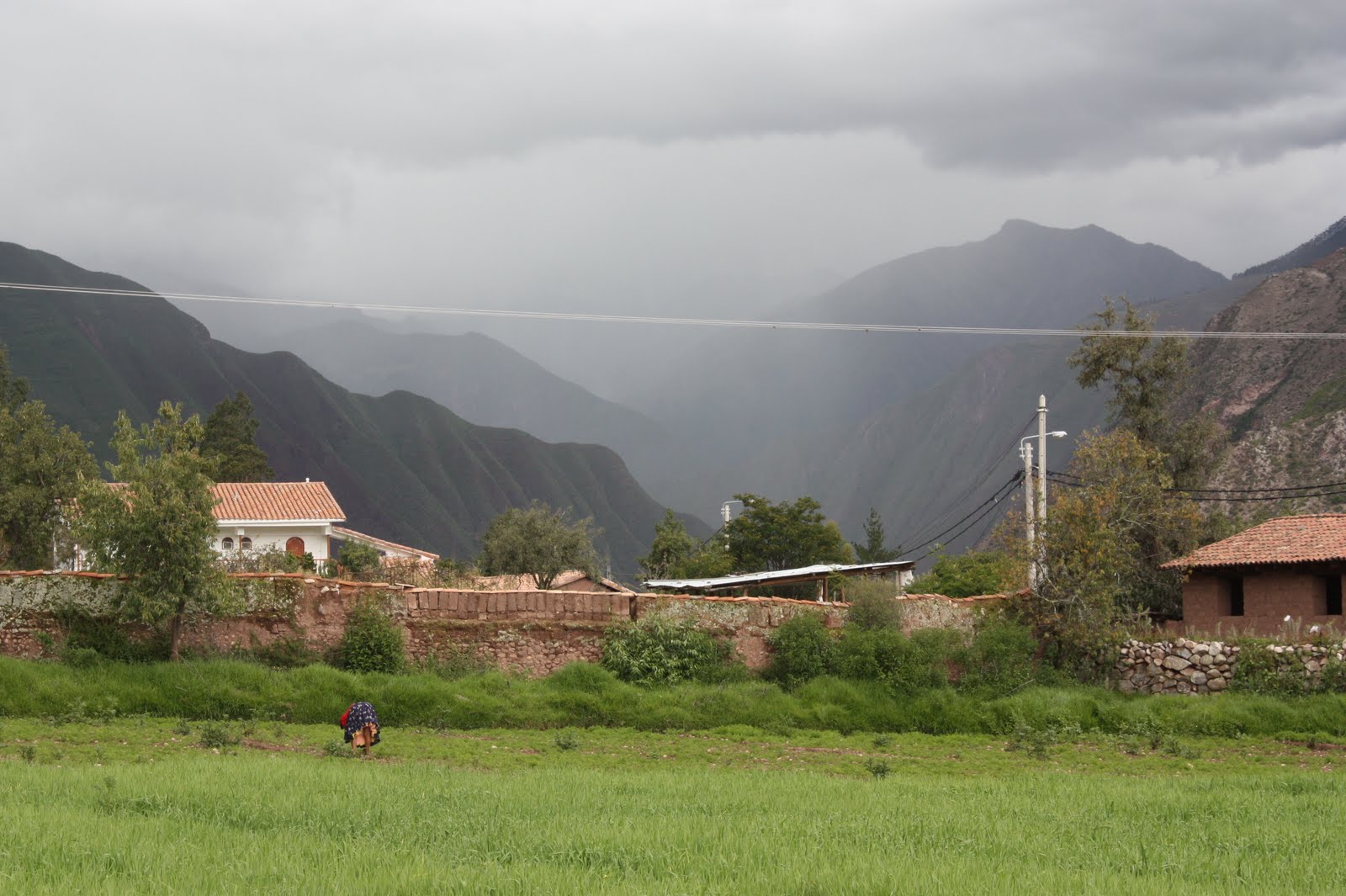
A view from our site looking east, with an afternoon rainstorm coming up the valley. One really interesting thing we noted today was how green the south faces of the mountains are (to the left of the photo) and how rugged and barren the north faces are (on the right of the photo). Because the sun in the Southern Hemisphere comes from the north, the north face of the mountains must get baked, while the southern face enjoys the wet season and the Sacred Valley's subtropical microclimate.

Step out the seminary and look left down Calle Belen. Turn right at the green door and then left down the alley, and you're at the seminary's new site.

A view up a typical Urubamba street toward the mountains. The little pom-pom looking things on the power lines are air plants.

Sunday, February 20, 2011

Just Another Day in the Life of an Architect

Today I attended a programming meeting, visited a site, was taken to lunch by a client . . . and took a shower in a tiny room with a toilet, a shower-head, and a drain in the floor. All in a day's work here in Peru!

Yesterday, the EMI team flew together from Lima to Cuzco and were met at the airport by some of the Seminary leaders we will be working with this week. After strapping our luggage on top of a van and in the back of a truck, we split up the team. Some headed back on the two hour drive through the mountains to the Seminary in Urubamba, while the three architects (for the master plan, church, and dormitories--that's my part) ate lunch in Cuzco with the ministry leaders and walked around to get a bit of a feel for the local architecture and construction. Lack of sleep, long travel the day before, and altitude made for a bit of a light head, but a good night's sleep in a town at a lower altitude seemed to have cleared things up a bit.

This morning the team ate breakfast together and a few shared their testimony. I spoke a bit about myself, and Latin America and Kim's and my adoption story featured heavily in the "tell us a bit about yourself and the things God's been doing in your life" talk. The team is great, and I think it will be a great encouragement to be working with other professionals (architects, engineers, and clients) who are Christ focused. Today, one of the EMI leaders said, "It's amazing the collaboration you get when you take money out of the equation and insert Christ." The more I learn about EMI, the more their mission and their organization impresses me.

We went to church with the ministry this morning. The service was in Spanish, but I was actually able to understand quite a bit of it with my Portuguese. I must give credit where credit is due, though, it was very-well-enunciated Spanish by a gringo pastor who's been here in Peru for 15+ years.

Following church, the ministry took us out to a delicious lunch, and afterward we headed back to the current seminary campus for a programming meeting for the Church component of this week's EMI trip. The programming meeting is basically getting all the designers, the EMI leaders, and the client representatives in the room together to talk about the vision for the project: how many people need to fit in the church? Do you need classrooms? What's your vision for the future? And many more.

The project this week is really for two clients--one a church and one a seminary--who work very closely together here in the town of Urubamba. The seminary, which focuses on educating Peruvian nationals and Quechua natives, owns a large plot here in town a few minutes' walk from their current campus, and they want to develop a master plan and a few initial buildings to start moving forward with a long-term vision of expansion and moving from their current location. The church that they are associated with is planning to buy a portion of the site to build a new church as their current church has reached capacity. It's a complex relationship we're still working out, but the three architects and one architectural intern on the team will be working together this week with the rest of the volunteer engineers and EMI staff to provide a vision that will help the ministries raise funds and make the vision a reality. This week is mainly for setting that vision and schematic design, and then construction documents will follow over the next few months as the volunteers work from home in conjunction with EMI's Latin America office in Costa Rica. One architect will be in charge of laying out the master plan for the seminary, another architect will be focusing on the design of the church and their needs, and I will be designing the dormitories which are to be phase 1 of the seminary's preparation of the new site for their move.

After the programming meeting, the architects walked over to the site. It really is a stunning site with so much potential. It is surrounded by a huge adobe and stone wall with cactus growing on top (add that to my list of things I love about Latin America!), has a few existing buildings and a chapel under construction, and sits on a slight hillside in the shadow of the Andes. Beautiful. Stunning even now in the rainy season, with the wet vegetation and clouds nestling around the peaks of the mountains.

The design wheels are already turning for us architects, but we still have more meetings tomorrow morning for the dormitory programming (that's my part!) and seminar master planning. We have to be careful to not get ahead of ourselves!

In Cuzco, a Spanish colonial church built on Inca foundations. The Inca didn't use grout--all the stones are shaped and fit perfectly together.

A pretty interesting building in Cuzco. I really like the arched arcade, the window/balcony composition on the facade, and the unfinished side, showing the constrained masonry (concrete frame, masonry infill) so prevalent here.

Party in the front, business on the side! Again, constrained masonry construction, but only stuccoed on the facade. A money-saving technique I'm sure.

I love this, another building in Cuzco. Stone base. Clean stuccoed facade. Minimal window details. Exposed rafters. Use of color on the details.

Crossing the mountain pass from Cuzco into the Sacred Valley of the Incas, where the town of Urubamba is situated.

The wall around our site in Urubamba. Adobe, mud, stone (some of it from glaciers!) and cactus on top. Yes, the cactus is for security. Much prettier, though, than broken glass bottles or barbed wire!

The new seminary site is on a small sloped ground. The building under construction is a chapel. The white building in back (which I think looks pretty cool, but I didn't have time to visit before we lost daylight) is a house. The mountains are such a prominent feature of the site. The forest behind the site to the north is Eucalyptus, which is a really beautiful, tall, slender tree.

This is the corner of the site where they imagine the church going, looking west toward the center of town.